Want heat training built into your training plan? Join our pilot waitlist →
What if someone told you that you could get faster not by working out more, but instead by kicking up your feet and relaxing for ~20 mins a few times per week in the sauna or hot tub? I’m talking about one of the hottest trends in endurance training: heat training!
You probably have already heard athletes and coaches talk about using heat training to prepare for hot weather races so that you can be heat-adapted and race faster in the heat. But do you know what also helps you run faster in the heat? Just being fitter and faster at regular temperatures. So in some ways, it’s unsurprising that this relationship between aerobic fitness and heat adaptation is bidirectional. Being fitter makes you withstand the heat better ↔ being heat-adapted makes you fitter.
A quick, non-negotiable disclaimer first: heat is a real physiological stress, and it can be dangerous. People with heart conditions, blood pressure issues, pre-existing medical conditions, or who are pregnant should not start heat protocols without a doctor’s sign-off. Talk to your physician first. This is a post from a (relatively fast) runner, but not medical advice.
Okay, let’s nerd out
There’s a growing body of research from the last ~20 years that demonstrates this relationship. A 2007 study of competitive male runners showed that sitting in a sauna for ~30 mins post exercise through a training block of 3 weeks improved blood plasma volume by 7% and run-time-to-exhaustion improved by an amount equivalent to roughly a 1.9% gain in an endurance time trial.
A 2022 study of elite cyclists found that after 5 weeks of 5x50 min training sessions in a heat chamber or heat suit, their hemoglobin mass and endurance performance increased.
Most recently in 2025, a study on 10 well-trained runners (Average VO2 max of 64.5) did hot-water immersion (aka hot tub) for 45 mins, 5 times per week, for 5 weeks, and found
- Hemoglobin mass up ~4%
- Blood volume up ~5%
- VO2 max increase by ~4%
- Velocity at VO2 max increased by 0.8 km/h (that’s the speed where you max out your VO2 — like going from running 5:22 min/mi → 5:08 min/mi pace!!)
A current theory behind these results is that humans are evolutionarily adapted to heat stimulus. The ability to cool ourselves, to sweat and endure, has been a superpower for humanity. In response to heat, we sweat and pump blood to our skin surface to dissipate heat, which requires more circulating blood volume.
This causes our body to increase blood plasma volume. The increase in plasma in our blood causes dilution because now the ratio of blood cells to total blood volume is lower (even though absolute volume of red blood cells is the same). The drop in concentration stimulates your body to release its own natural EPO — the hormone that tells your bone marrow to build more red blood cells.
The result over the course of weeks is increased red blood cell count, meaning increased total hemoglobin mass. More hemoglobin = more oxygen delivered to muscles = higher VO2 max and better endurance performance in all conditions, not just the heat.
These research results are truly insane! However, as a big data gal at heart, the research alone at such small N wasn’t enough to fully convince me. It’s the fact that professional athletes across all endurance sports are using heat to get gains. The world’s best cyclists like Tadej Pogačar and Jonas Vingegaard. Olympic gold medalists in the triathlon like Kristian Blummenfelt and Gwen Jorgensen. Professional ultra runners like David Roche and Kilian Jornet.
If the science all sounds a bit familiar to you, you might be thinking this is super similar to the effect of altitude training. And you are right!! While the mechanisms are slightly different, both have the effect of increasing red blood cells and therefore hemoglobin mass. Altitude training has been and still is a key tool for endurance training because of that reason. But the beauty of heat training for your everyday non-professional athletes is that it is so much easier to incorporate into your daily life. If you don’t live at altitude and have a job or life that prevents you from spending multiple months per year traveling to places like Colorado or St. Moritz (i.e. most age-group athletes), then heat training might be for you! And even if you do have access to altitude… why not both?
Want help building your heat training protocol? Join our heat training pilot waitlist and we’ll build it right into your Toga plan. Otherwise, read on to DIY it 👇
How to incorporate heat training
Major disclaimer again: this is NOT medical advice. I’m a runner sharing what I think works. But heat can be dangerous, so please please please consult your doctor — especially if you have any pre-existing risks or medical conditions — before trying heat training.
Passive vs. active heat training
If you follow some pro athletes, you may have seen some of them use the sauna, others the hot tub, and still others bike or run in tons of extra layers. These are examples of both passive and active heat training. Personally, I’m a bigger fan of passive heat training because it just feels nice 😊
Active heat training means exercising in the heat. For example, wearing extra layers while biking outdoors, going for an easy run outside on a hot and muggy east coast summer day, or in more extreme cases wearing a purpose-made heat suit while running or cycling. Active heat training is a useful tool, but can come with more risks since thermal stress adds to the overall training stress of your session. If you’re too hot, you can compromise the quality of the session or easily overcook yourself. In practice, if doing active heat training, we recommend limiting active heat sessions to easy aerobic sessions only.
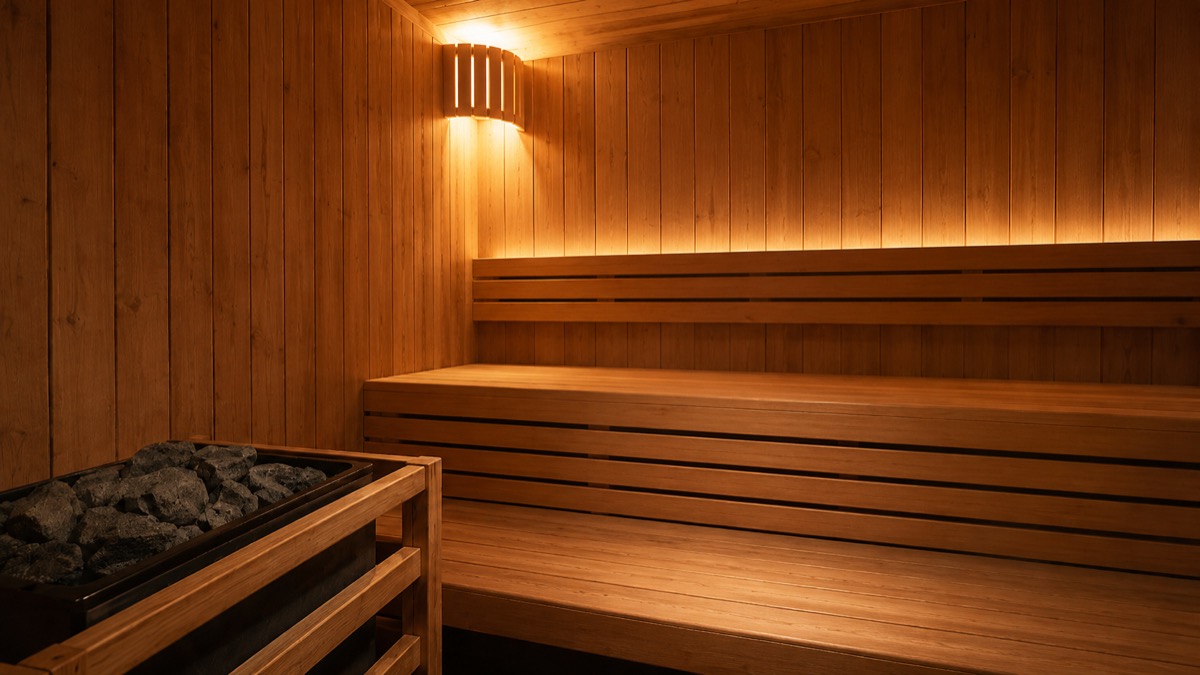
Passive heat training means getting exposed to heat without exercising. It means being as cool as a cucumber left in the sauna. Athletes can sit in a sauna or hot tub for 15-30 mins, ideally after your run when your core temperature is already elevated. The pro of passive heat training is that it doesn’t degrade the quality of your core workout sessions, while also being relatively relaxing, especially once you’re somewhat heat adapted. As a runner who always forgets to stretch, I use my sauna time to work on eventually touching my toes.
My Boston marathon build heat protocol
I ran a 5+ minute PR at the 2026 Boston Marathon for a final time of 2:38:44.
Major caveat: the PR was a result of many changes in addition to passive heat training (higher carb fueling, new super shoes, more training, etc.). So I do not know how much of my result can be attributed to heat training if anything at all. But what I do know is that the passive heat training made me feel good and I plan to continue using heat training in my next marathon build.
The actual Boston protocol
- Passive heat only - this was my first foray into heat training, so I wanted to keep it easy.
- Began mid January and continued all the way until the race on April 20
- Frequency: 2-3 times per week (occasionally just 1 time per week when didn’t have time)
- Directly post exercise (sometimes just an easy run, sometimes after a hard workout, sometimes after an easy elliptical)
- 15-25 minutes of sauna at my local gym
- At the beginning, 15 mins was my max and I would feel too hot afterwards
- But by the end of the training cycle, 25 minutes was no problem and I felt like I could have stayed longer, but time is money so I got out of there.
- HYDRATE HYDRATE HYDRATE - I made sure to drink tons of water all training block, but especially on days I sauna-ed. Just think - where does all the water come from for your blood volume gains??
- And if you’re a salty sweater like me, don’t just drink water - take electrolytes too!
- WARNING - there was one week when I did not have access to a sauna, so I decided to draw myself a hot bath. I would strongly advise against this unless you have someone else supervising as well as a thermometer to accurately measure water temp / your body temp. I had no thermometer, so just vibed the bath temperature. I could barely stay in for a full 10 minutes (when sauna-ing for 25 mins was no problem for me). When I got out, I was so dizzy that I had to lie on the floor for 20 mins afterwards. DANGEROUS!!!! Never doing that again.
My current heat training protocol
I’m sticking to the exact same protocol as Boston with one small addition of introducing active heat. And the beauty of the east coast summer is… I’m going to do this by just running outside in July and August! Any day when the feels-like temp is above 85 degrees F is going to count as an active heat session (whether I want it or not) in my training log.
Recommended framework for heat training
If you are interested in trying out heat training, I recommend starting with the following passive heat protocol:
- Method: Sauna or hot tub - whichever you have easier access to!
- Timing: Ideally right after an easy run when your core temp is already elevated. But if it’s more convenient to do later in the day, pick whatever fits your life best!
- Dose: Start small - 10-15 mins. If that’s easy, then gradually build duration a couple minutes at a time, building up to 25-30 mins as you tolerate. Never push to dizziness or feeling unwell, get out immediately!!
- Frequency: 2 sessions per week. You can add a 3rd or a 4th if you have lots of time. But consistency over time is the key.
- Track your progress: Log the duration of your heat sessions, your perceived effort, and heart rate. Also log your RPE during key training sessions. Track how it changes over time.
- Other tips:
- Hydrate aggressively around your sessions
- Do NOT cold plunge right after!! (you’ll blunt some of your heat adaptation)
- Keep passive heat during taper! When tapering for a race, your blood volume can shrink quickly due to decreased activity. To help counteract the blood volume reduction while still allowing your legs and body to freshen up, maintain 1-2 sessions of passive heat per week
If you’ve already experimented with passive heat and want to start incorporating active heat on top of your passive heat sessions:
- Method: If it’s hot where you live, congratulations! Free active heat training. Start by just slightly overdressing by a layer or 2 during an easy session (run or cross train), enough to make you sweat a bit, but not enough to really overheat.
- Dose/Timing: Do it for 20-40 mins during an easy session. For example, if your easy run is 60 minutes, bring an extra layer to put on top in the last 30 mins. Do NOT use active heat for quality workouts.
- Frequency: Start with once per week. If you’re also doing passive heat training, I would leave it at 1!
Always remember safety first
Broken record, but I can not stress this point enough: heat training is powerful but can be dangerous. Always consult a clinician first! If you start feeling too hot, nauseous, dizzy, etc. during heat training, stop immediately. Don’t overcook yourself!
Build your heat training protocol with Toga
There is still a gap between what’s measured in small-scale controlled lab experiments and what actually works in real life, especially when you add in the variables of different bodies, schedules, climates, and general life chaos. A lot of the real world evidence still lives in anecdotes and some studies indicate that the effects and dosage of heat training are different on male vs female athletes.
At Toga, we’re piloting adding structured, minimum-effective-dose heat protocols to athletes’ training plans, tracking how it fits into real-world training and the actual outcomes of these interventions. Our hope is to turn these scattered anecdotes into measurable, personalized guidance at scale.
So if you want heat training built into your next training cycle, join the pilot waitlist below!
Happy training!
Maryann
hot girl summer → fast girl fall
This post is for education, not medical advice. Always consult a physician before beginning any heat-training protocol, especially if you have any cardiovascular condition, are pregnant, or take medication that affects blood pressure or hydration.
← All posts