I used to think that hitting the wall in a marathon was inevitable, and sure if you trained really hard, the wall would come later or it would be a smaller wall, but the wall would be there no matter what.
But that all changed once I started high carb fueling. At Boston this spring, I had ~115-120g carb/hr, set a huge PB (2:38!!), and ran the last 5 miles as my fastest miles of the race. There were many factors that went into that PB, but I believe high carb fueling was one of the biggest factors.
Quick disclaimer: I’m a (relatively fast) runner sharing what’s worked for me and what the research says. This isn’t medical advice, and if you have any related medical conditions, please talk to your doctor or a sports dietitian first.
The old advice was not enough
When I first started running marathons, the advice I’d always hear was 1 gel every ~4 miles, but the quality of that advice can vary wildly depending on the gels you’re taking and the speed you’re running. If you run 5-7 min pace, that is taking a gel every 20-28 mins (reasonable). But if you’re running 10-12 min pace, that’s closer to 45 mins (less reasonable). But also, ALL GELS ARE NOT CREATED EQUAL (a lot more on this below). Some gels are 20g carbs other are 40g.
How this played out for many runners was taking in somewhere between 30-60 g carbs/hr. For my first marathon (Paris 2022), I was having about ~50g carb/hr. The race went well for my debut marathon, but I definitely felt the wall in the last 3-4 miles. But today, 60g carbs/hr should be the absolute floor, and I’d dare to say that every one of us, regardless of speed, should be doing a lot more.
High-carb fueling has been taking over cycling, and triathlon for a long while now, and it’s finally made its way to running. So let’s dive into what it is, why it works, and how to try it for your next marathon!
Why carbs matter so much in the marathon
Your body stores carbohydrates as glycogen in your muscles and liver. But even when you’re fully loaded, it’s not enough to cover the energy expenditure of a full marathon. Especially at marathon pace, most of your energy is coming from carbs. So that feeling of hitting the wall is what happens when those stores run empty.
With high carb fueling, and fueling the marathon in general, you’re trying to keep your engine running strong by taking on as many carbs as you can absorb. And the beautiful thing about carbs is that it not only helps your performance on the day, it also leads to better recovery for tomorrow. That’s also why it’s important to employ high carb fueling for your long workouts as well!!
The science: why you need two types of carbs in your gel
Part of the reason why traditional guidance used to cap at 60g carb/hr was because of how your gut absorbs glucose through a transporter called SGLT1. This transporter can only absorb around 60g glucose/hr. And then any excess unabsorbed glucose just sits in your gut and causes GI distress.
But luckily for us, we actually have a different transporter called GLUT5 that absorbs fructose (aka a second channel for more carbs). This is why it is so incredibly important to make sure you are taking in gels/fuel that have both glucose AND fructose. Many modern gel brands (SIS Beta Fuel, Maurten, Precision, etc.) have dual source gels, but there are still a lot of gels out there which don’t!!
So it’s really important that you read the label of your gels because they are NOT all the same. Even within dual source carb gels, consensus now is that the 1:0.8 ratio of glucose to fructose is better for absorption than 2:1. But, I’d still say 2:1 is much much much better than glucose only. Another important factor for gels is their size. Gels range in size from 20-50g carb. I personally really enjoy the 40g gel size because it gives you a lot more bang (carb) for your buck (for how many gels you need to carry) without being too much bigger than the 20-30g gels.
How to read a gel label: You want a glucose source and a fructose source.
- Glucose sources: maltodextrin, dextrose, glucose syrup
- Fructose sources: fructose, sucrose (table sugar is half glucose, half fructose)
(I love carbs + glucose and every time I think about high carb fueling, I think about this song my high school biology teacher used to play.)
So how much should you take?
tl;dr as much as you can stomach without GI distress!
Baseline is 60-70g carb/hr. This does not count as high carb fueling, but is doing the basics of fueling. Ideally, from there you work your way up to high carb at 90-100g carb/hr. And then once you are feeling good there, then experiment with even more 100-120g. I haven’t heard of that many runners (but have definitely heard of triathletes and cyclists) going as high as 150g/hr or higher, but if you don’t encounter GI distress with more, then I’d go for it!
In general, there is no single magic number for everyone. The bigger takeaway is that more carbs is better than we used to think, and that most of us can handle more than we realize if we train for it.
Useful tips for high carb fueling
- Practice practice practice! Unless your GI is blessed, you’ll need to train your gut to take in high carbs. Don’t be discouraged if you have some GI distress at first! My first long run pushing 100g/hr, I felt a bit nauseous afterwards. But I tried again the next long run workout and had no issues. This is quite common and something you can work through by training your gut to absorb more carbs.
- Increase gradually each long run (ideally long runs when you are practicing race quality effort). Try increasing by 10-15g/hr each run. If you experience some discomfort, stay there for another workout. If you feel good, progress up until you hit your target.
- Take fluids with or right after taking a gel. Your gut uses water to help you digest and absorb gels, so it’s helpful to chase each gel with water or a not-too-concentrated sports drink. This can help with mitigating GI distress
- Most people space out their gels every ~20-30 mins, but if you struggle with the frequency of taking gels, try a bigger gel (50g carb) that you can take less frequently. On the flip side, if you like slurping down smaller gels more frequently, that works too!!
- Start early! You can take your first gel ~15 mins before the start to begin topped up!
What I take in my marathons
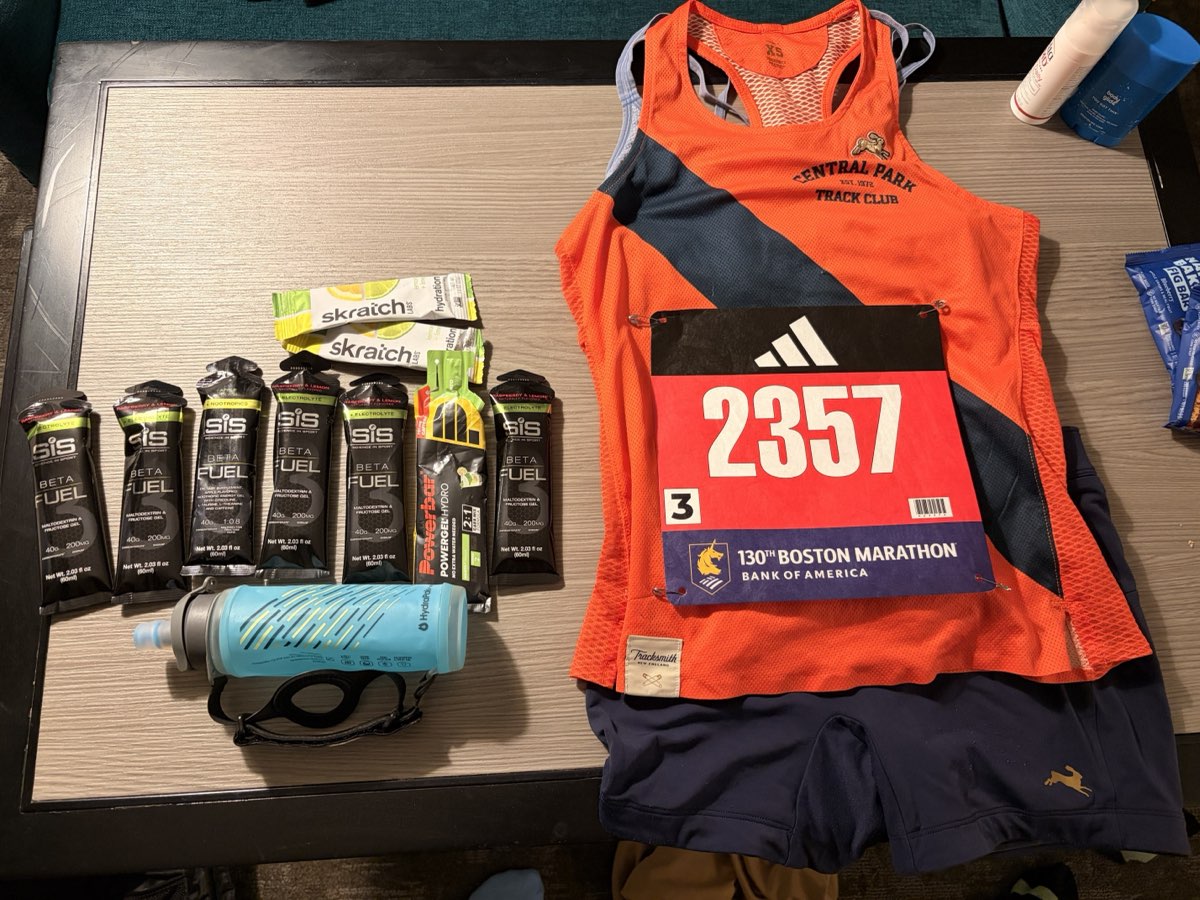
Here’s my exact fueling plan I used in Boston to hit ~115-120g carb/hr. I plan to repeat this for my upcoming marathon at Chicago:
Totals: 290-310g carbs + 250mg caffeine
- 5 × SiS Beta Fuel + Electrolyte gels (40g carbs each)
- 1 × SiS Beta Fuel Nootropics gel (40g carbs, 200mg caffeine, 200mg L-theanine)
- 1 × PowerBar PowerGel Hydro Mojito (25g carbs, 50mg caffeine)
- 1 handheld bottle with a scoop of Skratch Labs raspberry lemonade (20g carbs)
- 15-25g on-course Gatorade every other aid station (alternating with water)
Timing
- 10-15 mins before start: Powerbar powergel hydro mojito
- 20min - SIS Beta Fuel + constantly sipping handheld Skratch
- 45min - SIS Beta Fuel + constantly sipping handheld Skratch
- 1h5min - SIS Beta Fuel Nootropics + on course water/Gatorade
- 1h30min - SIS Beta Fuel + on course water/Gatorade
- 1h55 - SIS Beta Fuel + on course water/Gatorade
- 2h20min - SIS Beta Fuel + on course water/Gatorade
During this training block, I consistently took 100-120 g/hr on long run workouts, and at least 40g for shorter workouts under an hour.
The takeaway
High carb fueling was a huge unlock for me. It’s not just about avoiding the bonk at the end of long runs and races, it actually made it so I felt good beyond mile 20 in workouts and during my last marathon. It’s truly an incredible feeling that reminds me of the first time I wore super shoes. Free performance, free speed!
So I encourage every marathoner out there, try it out! Practice on your long runs, and then get ready to PR!!
Happy training (+ fueling)! Maryann
Want help dialing in your race-day fueling? Ask the Toga coach! It can help you build a fueling plan around your goal pace, your race, and the products you like.
This post is for education, not medical advice. Talk to your doctor or a registered sports dietitian before making major changes to your fueling, especially if you have diabetes, GI conditions, or any other medical considerations.
Frequently asked questions
At least 60g of carbs per hour, and most runners can train their gut to handle much more. Start with a baseline of 60 to 70g per hour, work up to 90 to 100g for high-carb fueling, then experiment with 100 to 120g once that feels good. I took about 115 to 120g per hour at Boston.
Your gut absorbs glucose through a transporter (SGLT1) that maxes out around 60g per hour, and unabsorbed glucose sits in your gut and causes GI distress. Fructose uses a separate transporter (GLUT5), so gels with both sugars let you absorb more carbs per hour. A 1:0.8 glucose-to-fructose ratio is now considered better than 2:1.
Check the label for both a glucose source and a fructose source. Glucose sources include maltodextrin, dextrose and glucose syrup. Fructose sources include fructose and sucrose, since table sugar is half glucose and half fructose. If maltodextrin or dextrose is the only carb listed, the gel is glucose-only.
Practice on your long runs, ideally ones at race-quality effort, and increase your intake by about 10 to 15g of carbs per hour each run. If you feel some discomfort, stay at that level for another workout before progressing. Some GI distress at first is common, and it usually improves as your gut adapts.
Most runners take a gel every 20 to 30 minutes, with the first one about 15 minutes before the start. If gels that often are hard for you, use bigger 50g gels less frequently, or take smaller gels more often if you prefer. Chase each gel with water or a not-too-concentrated sports drink.